

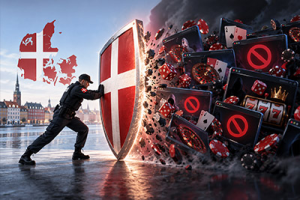
 Denmark’s gambling regulator has blocked another 98 illegal gambling sites, adding to a broader enforcement push against unlicensed operators in one of Europe’s more established regulated markets.
The Danish Gambling Authority, Spillemyndigheden, announced the latest court-approved blocking action in August 2026, bringing the total number of illegal gambling sites blocked since 2012 to 870.
The action follows a particularly active year for enforcement. In 2025 alone, Spillemyndigheden blocked 334 illegal gambling sites, drawing renewed attention to the scale of unlicensed activity still operating alongside Denmark’s regulated gambling market.
Recent figures also show the scale of the legal sector. Danes spent 760 million Danish kroner on the liberalised gambling market in July 2026, while online casino became Denmark’s largest gambling category for the first time across 2025.
The enforcement side of the market tells a different part of the story. With hundreds of unlicensed sites identified and blocked, illegal gambling remains an active concern even as AML oversight, supplier requirements and other regulatory controls continue to develop.
The 2026 restrictions involving Inpay A/S also showed how regulatory action can extend into gambling payment infrastructure, while September amendments to Denmark’s Anti-Money Laundering Act introduced additional requirements for gambling operators covering areas including risk assessments, sanctions controls and independent auditing.
So, what does the blocking activity say about the Danish gambling market, and what can the enforcement data tell us about its regulatory maturity?
How Denmark Tackles Unlicensed Gambling
The August blocking of another 98 illegal gambling sites provides one of the clearest recent examples of how actively Denmark’s gambling regulator monitors the market.
That action follows the 334 illegal gambling sites blocked by Spillemyndigheden in 2025. The three-digit figure is useful because it tells us how many illegal sites the regulator actively identified and blocked, rather than just how many operators went offline of their own accord.
Under Denmark’s Gambling Act, gambling activities offered to the Danish market generally need to be licensed by Spillemyndigheden. When operators do not have the required authorization, the regulator can seek court approval to have their domains blocked, creating a mechanism to address activity outside the licensed market.
In 2026, regulators also ordered Inpay A/S to stop entering into new partnerships with iGaming businesses after an inspection revealed anti-money laundering failures. That case highlights how regulatory scrutiny can reach different parts of the gambling ecosystem.
AML requirements have continued to develop as well. Amendments to Denmark’s Anti-Money Laundering Act adopted in September introduced additional obligations for gambling operators, including requirements relating to proliferation-financing risk assessments, financial-sanctions controls and independent auditing.
Supplier requirements have also changed. The Danish Gambling Authority updated its certification program for betting and online casino, introducing supplier licenses and increasing scrutiny of suppliers connected to high-risk jurisdictions.
Given these measures, Denmark’s gambling regulation is multi-dimensional, going beyond the simple issuance of licenses.
What the Enforcement Record Shows
Revenue figures tend to be most prominent and can be useful for understanding the direction and size of Denmark’s gambling market, but they won’t tell you much about how the market is regulated.
For instance, gambling revenue increased 12.8% year over year in July 2025, while online casino went on to become Denmark’s largest gambling category across the full year.
More recent figures show Danes spent DKK 760 million on the liberalised gambling market in July 2026.
Neither fact nor figure says much about compliance, though, which is arguably more important than growth and size. Growing markets can still have issues with unlicensed operators, money laundering or suppliers that fall short of regulatory requirements.
Operator marketing offers a different perspective, detailing how gambling products are being promoted, but not the compliance systems behind them.
To fill in the gaps left by revenue data, industry observers can turn to enforcement signals mentioned previously. Reprimands, supplier requirements, restrictions and domain blocks provide evidence of how the regulatory framework is functioning even when businesses fall outside its requirements.
The latest 98-site blocking action adds another recent data point to that record.
The Role of Transparency
Enforcement metrics foster transparency for Spillemyndigheden. They show how the authority identifies compliance problems, responds to activity outside the licensing framework and updates its requirements as the market changes.
Denmark openly publishes its enforcement decisions, which makes these developments available for independent analysis. Observers can look to regulatory data and expert assessment of casinos on the Danish market when they want to evaluate legitimacy.
They can also compare blocking announcements with the regulator’s licensed operator lists to distinguish illegal sites from those operating legally within Denmark’s licensing framework.
While transparency is always relevant, it becomes particularly important as Denmark prepares for more regulatory changes in 2027, including new rules affecting marketing, increased funding for gambling addiction treatment and more sanctions.
The September 2026 AML amendments also show that regulatory change is already continuing ahead of those wider reforms.
A mature regulatory market should not just have licensing requirements in place but be able to communicate those requirements, enforce them consistently and make enough of that information available for outside observers to understand what is happening in the market.
For Denmark, those publicly available enforcement decisions and regulatory updates offer that visibility. Instead of letting analysts focus solely on revenue growth and operator claims, they give them the ability to examine the regulatory record itself.
Comparing Denmark’s Approach to Other EU Markets
Denmark exists alongside several European markets that are actively tackling unlicensed gambling.
The Netherlands has intensified enforcement against illegal operators by targeting social betting and advertising compliance in 2026. Similar to Denmark, the Dutch regulator uses enforcement measures to address unlicensed gambling activity.
Other Nordic markets vary in their approach. Sweden operates a licensing system, while Norway and Finland have traditionally relied more heavily on monopoly-based models. Because those differences affect how regulators approach market access and enforcement, direct comparisons aren’t straightforward.
Although using multiple enforcement tools isn’t unusual among European regulators, Denmark’s approach effectively combines licensing with several tools for dealing with activity outside the regulated market.
Licensing determines which operators can legally offer gambling, while domain blocking can restrict access to unlicensed sites. The public nature of Denmark’s enforcement also gives analysts a way to follow these measures over time.
Denmark’s model isn’t overly novel, but it is notable for its comprehensive approach in combining market access controls with multiple forms of active enforcement.
What Can Industry Observers Pay Attention To?
Companies operating in Denmark are looking at a market where compliance is an ongoing consideration.
That’s important for regulators and the wider market because it means compliance isn’t just limited to the initial licensing process. While operators are affected directly, recent action involving suppliers and payment providers shows that regulatory exposure can affect other businesses in the gambling market too.
The September AML amendments reinforce that point by adding further compliance obligations for gambling operators even as broader reforms remain ahead.
In the competitive landscape, blocking unlicensed sites can reduce the number of businesses competing outside the licensing system, while tighter requirements can change the costs and practical requirements of operating inside it.
All these regulatory changes are likely to affect competition, compliance and the balance between licensed and unlicensed gambling.
Future changes to responsible gambling and advertising, for example, could influence how operators structure their products and compete for customers, which could change what it takes to stand out.
The State of Denmark’s Gambling Market
The latest 98-site blocking action provides a more current snapshot of Denmark’s enforcement efforts, while the 334 sites blocked during 2025 show that the August action is part of a much broader pattern.
Together, those figures tell the broader public that Spillemyndigheden continues to actively identify and restrict access to gambling sites operating outside the licensing framework.
On a deeper level, the enforcement record offers another way to look at Denmark’s gambling market. It shows that alongside revenue growth and changing gambling habits, there is an ongoing effort to identify and disrupt activity operating outside the country’s licensing system.
Recent AML changes, supplier requirements and regulatory action involving payment providers also show that enforcement extends beyond the operators directly offering gambling products.
The broader enforcement record demonstrates where Denmark draws the boundaries of its regulated market and what happens when businesses operate beyond them—context that revenue figures alone cannot show.